While narwhals remain popular, blobfish are where the action is these days, apparently.
Thursday, March 26, 2015
Tuesday, December 23, 2014
NCSA "What's New" is gone, except for Archive.org
Longtime Net users will remember NCSA's "What's New" page, which predated the first search engines. I wanted to find something I remembered in it, but the page is now 404. Google has several "archives" of it, but they are all either 404s themselves, or only an archive of one month of links.
Luckily, the Wayback Machine (archive.org) has a snapshot from Dec., 1996, which crawled back to the whole What's New archives. This is a great example of the power of the Wayback, and the foresight of Brewster Kahle. "What's New" was incredibly important in the history of the Web.
Luckily, the Wayback Machine (archive.org) has a snapshot from Dec., 1996, which crawled back to the whole What's New archives. This is a great example of the power of the Wayback, and the foresight of Brewster Kahle. "What's New" was incredibly important in the history of the Web.


Saturday, May 18, 2013
Tuesday, April 02, 2013
TMMakers 3D prints coming back
The "Engineering & Design" club I'm coaching, called TMMakers, got a batch of printed 3D objects back last week:

Too bad Tinekrcad is shutting down! We can still use our academic license until August, but I'm looking for alternatives that meet our needs.
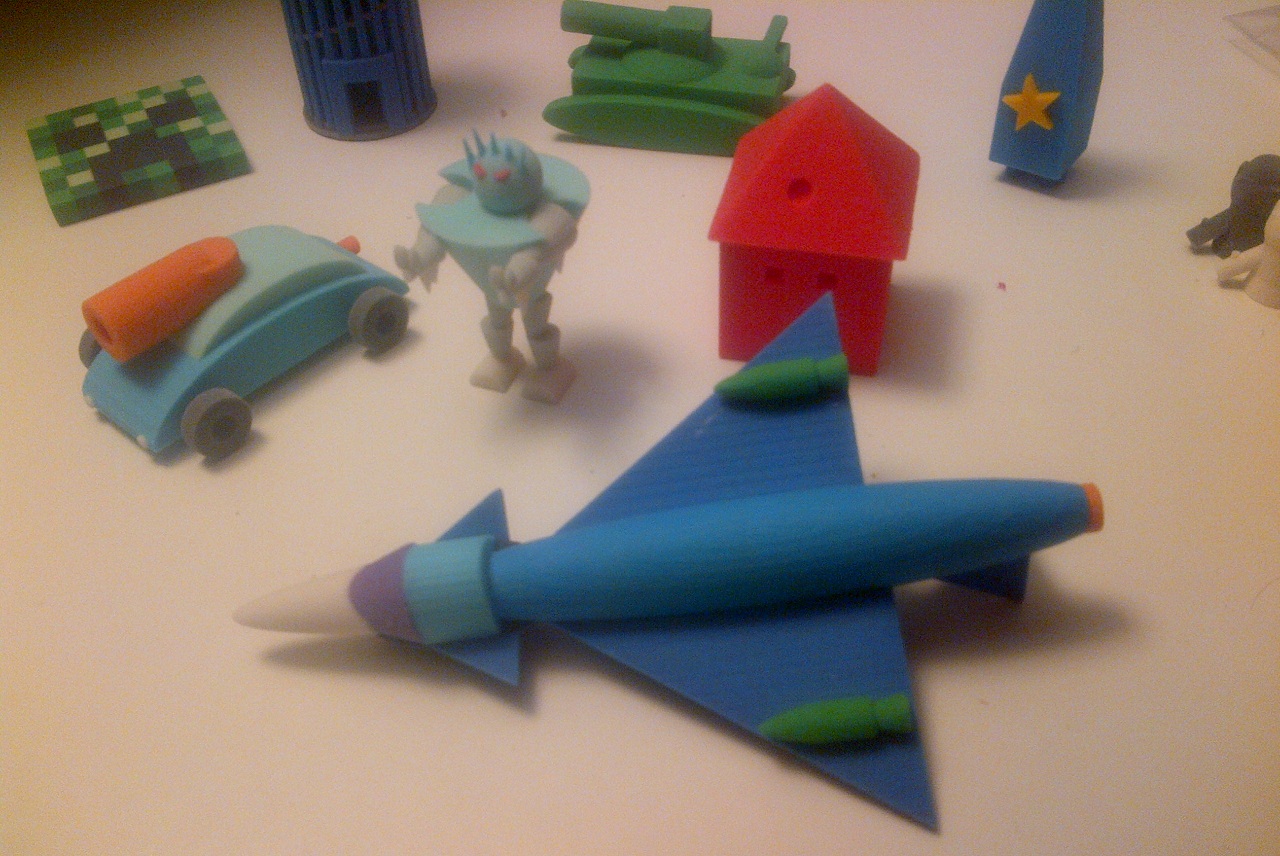
Too bad Tinekrcad is shutting down! We can still use our academic license until August, but I'm looking for alternatives that meet our needs.
Wednesday, November 14, 2012
"From STEM to STICK" now on YouTube
"Ignite Seattle" just put the speaker videos online from the night in August, when I presented "From STEM to STICK: How to Raise Engineers".
http://www.youtube.com/watch?
(I sound rushed because it's a five-minute format where slides advance
on you automatically, so I rushed.)
http://www.youtube.com/watch?
(I sound rushed because it's a five-minute format where slides advance
on you automatically, so I rushed.)
Friday, October 05, 2012
From STEM to STICK (slides/video)
It looks like Ignite Seattle got a slide-based version of my August talk, "From STEM to STICK", online (video + slides).
Wednesday, September 19, 2012
GoldieBlox
I'm backing GoldieBlox, a Kickstarter project to make a fun reading/building toy for girls. It seems well thought out. More like this, please.
Sunday, August 19, 2012
Ignite Seattle
I just had a great time speaking at Ignite Seattle 17. My talk was "From STEM to STICK: How to Raise Engineers". If you're interested in that, contact me. Thanks to folks who gave me positive feedback after :-)
The STEM club's blog is at http://laserclub.blogspot.com .
I've set up a From STEM to STICK site to hold links to the concept, etc.
The STEM club's blog is at http://laserclub.blogspot.com .
I've set up a From STEM to STICK site to hold links to the concept, etc.
Thursday, February 10, 2011
Fresh start on blog tools
After not posting for quite a while, I've updated my publishing setup, and hope to resume blogging now.
Tuesday, March 14, 2006
FoRK: Space-efficient Groove Recordings
As I mentioned in old bits on the FoRK list, I bought the hobby kit that makes an Edison cylinder recorder that records on plastic cups. (I still haven't assembled it yet, though.)
The cylinder recorder was replaced by the more space-efficient record discs, of course. (Edison fought that, as he fought many improvements of his work.) Anyway, I was just wondering what the most space-efficient format would be for a groove recording. And in a practical sense; what shape of medium would allow the biggest collection (in recorded hours) to sit in someone's closet?
Rectangular shapes fill up rectangular closets fairly well. But if the player is moving this rectangle in zigzags, like a CRT's electron beam, it seems a little tricky to swing the pickup needle around to the next groove. Even if that problem is solved, it might be best to have a looooong rectangle, so you canmaximize the straightaways and minimize the hairpin turns, if just for easier maintenance.
Friday, February 10, 2006
Doubly Maximal Lipograms
Cup of java in my hand, so warm,
A sunny, pinkish glow proclaims a morn.
Across a Sound, Olympic pyramids
Command a land from shiny, snowy lids.
About five years ago, I wrote a few examples of what I call "doubly-maximal lipograms"; writings missing the two most-common letters in English, "e" and "t". I misplaced my notebook containing them, though.
Yesterday I decided to start anew, one or two a day, and with a goal in mind for each piece. Yesterday's was: "If any of you, man, woman, or child, can show a fair claim for avoiding a union of him and his woman, you should say so now." Today's piece is the trochaic pentameter poem at top; today was the first day in a (rainy) month or so that I could see sunrise off the Olympics.
After my effort in 2001, I came across a comment in Douglas Hofstadter's "Le Ton beau de Marot" (p. 107), where he notes that in 1983 he and a few friends started speaking in plain maximal lipograms (speaking without words with "e"). They then tried speaking in doubly-maximal lipograms (though he did not give it a name). He wrote:
I'm going to withhold judgment on how difficult it is after practice. It certainly is hard when starting out. I suspect it's not so much the time you need to become fluent at single or double lipography, but rather the volume of output. That is, it may take having a few dozen lipograms under your belt to get the tricks of that lipogram form. If you're avoiding "e" and "t", that number of successes may take ten or twenty times as long as if you're just avoiding "e", but currently I do suspect that the tricks are out there. You will, however, probably find that you can be nowhere near as precise as you want. For example, I haven't thought of a good replacement for "three" (or tre-/tri- words), other than "four minus ... a singular?".
A sunny, pinkish glow proclaims a morn.
Across a Sound, Olympic pyramids
Command a land from shiny, snowy lids.
About five years ago, I wrote a few examples of what I call "doubly-maximal lipograms"; writings missing the two most-common letters in English, "e" and "t". I misplaced my notebook containing them, though.
Yesterday I decided to start anew, one or two a day, and with a goal in mind for each piece. Yesterday's was: "If any of you, man, woman, or child, can show a fair claim for avoiding a union of him and his woman, you should say so now." Today's piece is the trochaic pentameter poem at top; today was the first day in a (rainy) month or so that I could see sunrise off the Olympics.
After my effort in 2001, I came across a comment in Douglas Hofstadter's "Le Ton beau de Marot" (p. 107), where he notes that in 1983 he and a few friends started speaking in plain maximal lipograms (speaking without words with "e"). They then tried speaking in doubly-maximal lipograms (though he did not give it a name). He wrote:
We soon discovered that whereas in an "e"-less mode we felt hampered but were still able to say pretty much anything we wanted, in the new doubly deprived mode, we were virtually immobilized -- not a single pre-formed thought could be expressed without lengthy mental struggle, and usually not even then. Deleting just the one letter of highest frequency was debilitating but survivable; deleting the two letters of highest frequency brought us to our knees.
I'm going to withhold judgment on how difficult it is after practice. It certainly is hard when starting out. I suspect it's not so much the time you need to become fluent at single or double lipography, but rather the volume of output. That is, it may take having a few dozen lipograms under your belt to get the tricks of that lipogram form. If you're avoiding "e" and "t", that number of successes may take ten or twenty times as long as if you're just avoiding "e", but currently I do suspect that the tricks are out there. You will, however, probably find that you can be nowhere near as precise as you want. For example, I haven't thought of a good replacement for "three" (or tre-/tri- words), other than "four minus ... a singular?".
Wednesday, January 11, 2006
You're the "Art Museum" ?
When a singer covers a classic but wants to change something in the lyrics, it's best to sleep on it. And, usually, to forget it. Sometimes people make a change because the original is too risque, or too dated. But why did Anita O'Day feel she needed to change Cole Porter's "You're the Top"?
Instead of "you're the Louvre Museum", she sings "you're the art museum". Like we're supposed to remember what a "Bendel bonnet" is, but we can't recognize the most famous (and, for Porter, the "top") art museum in the world? The whole song is best-in-class references; genericize that and the song has no point. That most of the references are now obscure only makes them cooler.
Instead of "you're the Louvre Museum", she sings "you're the art museum". Like we're supposed to remember what a "Bendel bonnet" is, but we can't recognize the most famous (and, for Porter, the "top") art museum in the world? The whole song is best-in-class references; genericize that and the song has no point. That most of the references are now obscure only makes them cooler.
Tuesday, November 01, 2005
Sociology of Paper
Malcolm Gladwell has a popular article called "The Social Life of Paper". It argues in part that some of the most effective people are those whose "messy" desks are actually well-structured for finding information. Or rather, much of the knowledge work we do today is better supported by piles than files.
Yesterday Scripps Howard reported that a study by Pendaflex shows that the way people manage their desktop paperwork correlates with certain sociological or behavioral patterns. One interesting result: the messier the desk, the more education the person is likely to have. I don't know if "messier" is used in the underlying study; I'm using it as a placeholder for a pile-oriented desk versus a file-oriented desk.
Yesterday Scripps Howard reported that a study by Pendaflex shows that the way people manage their desktop paperwork correlates with certain sociological or behavioral patterns. One interesting result: the messier the desk, the more education the person is likely to have. I don't know if "messier" is used in the underlying study; I'm using it as a placeholder for a pile-oriented desk versus a file-oriented desk.
Thursday, September 29, 2005
Socrates and Google: Learning to Forget
Thought I'd share my post to the Humanist list (use of tech in
teaching and researching the humanities). The topic is needing time away from the computer, and our growing reliance on tech for memory.
------------------------
[Hide Quoted Text]
> From: Steven D.Krause
> Subject: Re: 19.304 contemplation and computing
>
> Of course, the problem of technology and "critical thinking" (or just
> "thinking") has been a problem for thousands of years.
> [ ... Socrates on Theuth and Thamus ... ]
> Substitute "digital communication" for "letters" and I think you can
> see how these things fit together.
Thamus was right. The mnemonic powers of pre-literate (as in pre-writing) societies astounds us today. Who among us can recite a three-hour epic poem?
However, Thamus only looked at the costs, and not the benefits. For example, it's been argued that Western Civilization's success in science could not have occurred in a non-literate society, because observations need to be written down if they are to be trusted with the passing of time, and properly analyzed.
Similarly, we today enjoy amazing benefits from being able to tap into the global Googlebrain that all Web users are collectively growing through their individual accretion of factoids and comments. But I agree with those who have said that in another decade, people will feel hopelessly lost if their Web access is taken away. Lost in the sense of feeling they are no longer themselves.
It used to be only hard-charging workaholics who felt anxious without access to their email. More and more, that feeling affects everyday people; if you don't experience it, you likely know someone who does. A similar dynamic affects people's growing reliance on search engines for recalling simple facts, and the use of blogs and wikis (I like Backpackit.com) to maintain personal memory (both short-term and long-term).
> [T]hey will be hearers of many things and will have learned nothing;
> they will appear to be omniscient and will generally know nothing;
Quite true. Like Thamus, I lament that aspect. It's wonderful that the Web helps people to learn so much. At the same time, you never know if someone mailed you something useful/clever/obscure/intelligent because they are such an intelligent, well-educated, interesting person, or because they did a 30-second search on Google. And I do think my brain is learning to become lazy; either I'm just forgetting how to remember, or I subconsciously know I'll be able to look something up again in the future, and it gets thrown out.
Friday, September 23, 2005
75 Years of Incompleteness
On October 7th, we'll see the 75th anniversary of Godel's unveiling of his (first) incompleteness. I'm now reading Rebecca Goldstein's excellent "Incompleteness", which not only explains Godel's theorems in simple language, but also provides the context both of the history of mathematics at that point, and of Godel's personality.
The book raises some thoughts:
* If there were no WWI, there would be no Vienna Circle (or Schlick's Circle, as it was originally called; there were many discussion circles in post-war Vienna). The modernist movement in Vienna, attempting to rebuild all thought on clean, solid foundations, was in part a reaction to everything in past thinking habits and assumptions, habits that to some had seemed to lead to the war.
* The stark constrast between Wittgenstein's classic, tortured brand of genius, and Godel's quiet, hermetic brand. Goldstein suspects, but cannot prove, that Godel was spurred on in his work, subconsciously at least, by the idea of shutting up the arrogant Wittgenstein.
(Goldstein notes that the fact that Godel could use only mathematics to say something metamathematical, even metaphysical, is in complete opposition to what Wittgenstein maintained about the limits of sayable things in a language.)
* Wittgenstein and Russell were both aristocrats. I knew this of each of them, but never really noticed that it was true of both of them at the time they were interacting at Cambridge. I'm not sure if it means anything, or if it's just an interesting coincidence.
* When Godel unveiled his idea at a conference (Oct. 7, 1930, in Konigsberg), it went almost completely unnoticed. He spoke for perhaps 30 seconds, in a quiet, casual voice (judging by everything else in his life), and was only 24 at the time. Had not John von Neumann took interest and buttonholed him later, it might have taken years longer for Godel's theorem to take hold. (He had been sitting on the theorem since the previous year, and throughout his life his unsent letters and papers far outnumbered his actual publications.)
Tuesday, June 28, 2005
Danny Hillis and Maxwell Smart
Wired has a piece about Applied Minds. Thinking Machines founder Danny Hillis clearly has a fondness for "Get Smart"; there's the phone booth as a hidden passage, the goofy passphrases, and even a Cone of Silence.
(John Battelle had a similar piece about Applied Minds a few days earlier.)
Co-founder Danny Hillis escorts me down a hallway that dead-ends into an old-fashioned red phone booth. The phone rings. He places receiver to ear.
"The blue moon jumps over the purple sky," he says, and hangs up.
Suddenly, the booth becomes a door, swinging out to reveal a vast, open room filled with engineers, gadgets and big ideas.
It's as if Willy Wonka's chocolate factory just yawned wide to welcome us. Only here, all the candy plugs in.
"This is where the secret laboratories are," Hillis says.
To our left, two employees chat behind a desk. Their conversation is a burbling, unintelligible stream. It's as if someone poured their words into a blender, then hit "puree."
That's because their speech has been scrambled by Babble, a gadget designed by Applied Minds, with office furniture company Herman Miller, for creating sonic privacy in workspaces without walls.
(John Battelle had a similar piece about Applied Minds a few days earlier.)
Thursday, June 23, 2005
Worst Graph Design In A While
It's been a while since I've seen a graph designed as poorly as this one.

Since the final UK price is roughly twice the US price, and since the final red dot is roughly twice as high as the blue dot, then we can conclude that three years ago, where the lines meet, both a UK house and a US house cost roughly... zero dollars.
Since the final UK price is roughly twice the US price, and since the final red dot is roughly twice as high as the blue dot, then we can conclude that three years ago, where the lines meet, both a UK house and a US house cost roughly... zero dollars.
Thursday, May 19, 2005
Great Quotes
1. On Attention And Respect
"Why is yet another milestone. Why implies that the child understands causality. When why appears, it's very important to treat it with the respect it's due. It's very tempting to answer these onslaughts of questions with 'Because', or 'That's just the way it is.' This is a dangerous path. The child who hears 'Because' as answer to 'Why is the sky blue?' will be the child who will answer his parent's question 'What did you do at school today?' with 'Nothing.'"
- McGuinness, C. & McGuinness, G., How To Increase Your Child's Verbal Intelligence, 2000, p.83.
2. On Giants
You've probably heard Newton's epigram: "If I have seen further, it is by standing on the shoulders of giants." Here's a twist I only heard recently:
"If I have not seen as far as others, it is because giants were standing on my shoulders."
- Harold Abelson, MIT
Wednesday, May 18, 2005
Print on Demand, and Hardcopy Copy Protection
You might be familiar with Print On Demand (POD) vendors like iUniverse and Lulu. They let you upload a document (say, a 300-page PDF) that customers can have printed into a softcover book on demand. The cost is only a little above the per unit cost of printing books in a traditional press run of 1,000 copies. This means you can print anything with essentially no overhead.
There's a subgenre of POD, called Variable Data Printing (VDP). This allows the document on the print server to be, in essence, "mail merged" with customer data from a database. So if John Doe orders a catalog from a company, the system can check John's previous order history and modify the catalog document just for him immediately before printing it. All customers can have a custom catalog.
So far, Variable Data Printing has not come to the well-known book publishers like iUniverse and Lulu. While it's not terribly practical for Lulu to host your company's customer database, there is a simple and useful form of VDP that they could provide; hardcopy copy protection.
Imagine that when you publish a book through Lulu, you also include in your book a reference to a web site that contains more information. For example, if you sell a cookbook, you might want to offer a companion web site with additional recipes, nutrition analysis, etc. You want this web site to require a code for entry, which you publish in your book, so that people must buy the book to use the web site.
Now, a normal book can only print one code. Well, a person could manually place a sticker with a code into the back of the book, but such a step breaks the efficiency model of iUniverse and Lulu; you have to use an automated system that requires no human intervention.
So Lulu offers you an option: along with your book document, you can upload a text file containing thousands of random-looking, unique codes. You edit your book document to contain a string like this: "###VDP:Code###". Whenever a customer orders a copy of your book, Lulu's system looks for the next unused code from your code file, and sticks it into your document wherever it sees the ###VDP:Code### string. Voila, you are now printing customized access codes, one per copy of the book.
(I concocted the ###VDP:blah### syntax because it's tremendously simpler than some full-bore XML solution. You only need to insert small snippets of text in the first place, and Lulu would want something that's both easy to implement and performs at high speed with large documents.)
Once Lulu can do this, they can offer other VDP possibilities, too. For example, ###VDP:Date### could be a placeholder for the date that copy of the book was printed.
Monday, May 16, 2005
On Seeing "Revenge of the Sith"
Yesterday I saw an advance screening of "Star Wars III: Revenge of the Sith" (RotS). There were several hundred game company employees and their guests, and I shared the general verdict that it was one of the better Star Wars movies. Lucas has tied the loose threads together reasonably well, I think, considering the corner into which he had written himself with the other five films.
While the scenery is visually stunning, there are also more emotionally-evocative moments than in all the other films. Lucas succeeds in doing something I didn't expect he could, or even should, do: he generates some sympathy for Darth Vader. Not just for Anakin Skywalker, but for Darth Vader (or rather, for the sliver of Anakin that remains alive in him). In that way, RotS actually elevates the original movie from simple Buck Rogers derring-do to a more substantial, emotional experience. I haven't watched Episode IV again yet, but I expect them to be powerful back-to-back.
The next paragraphs contains some SPOILERS. Since there are few surprises in the film as it is, you might want to skip this.
SPOILERS
SPOILERS
SPOILERS
Greek Tragedy
This script has more classic elements of myth than the others, too. There is "Faust". There is "Frankenstein". Most of all, there is "Oedipus Rex". While there is no sexual theme as in "Oedipus", RotS is a Greek tragedy. Not only does hubris bring down the hero, but, like Oedipus, he needlessly brings on the prophecy he tries to prevent. (Note that this is much more specific than just saying he has become what he swore to oppose.) Specifically, his drive for power is largely fueled by fear that Padme will die in childbirth. But it is his turn to the dark side, and not anything else, that causes her to "lose the will to live".
The Republic
It's somewhat hard to believe someone would fall for Palpatine's arguments and lies. But Palpatine has been Anakin's friend for years, he is the venerable leader of the Republic, and Anakin is ruled by his emotions. And he's only 21 or so. It's more difficult to believe the Senate falling for Palpatine's tricks, but largely that's because we don't see the cumulative effect of Palpatine's spin campaign.
As far as the average Senator is concerned, everything is fine with the Jedi Order until Palpatine declares in an emergency session that 1) they have attacked him, 2) they must *all* be destroyed, and 3) he is declaring himself Emperor. Even with an ongoing state of war, that's a lot for a Senator to swallow. I'm sure I'm in the minority, but I actually wanted to see more of the machinations of the Senate. The Fall of the Republic is, after all, the real story. Apparently, in the novel and elsewhere, there are mentions of additional security regulations and militarization of the Republic, but nothing like that made it into the film.
However, I did like the battle between Sidious and Yoda in the middle of the Senate Chamber, a beautiful place to show the actual, final battle over the Republic.
Order 66
"Order 66" is Darth Sidious's command to the clone troops throughout the galaxy to turn on and kill the Jedi they are with. In a movie with surprisingly few plot holes, I didn't like the way that was handled. That is, I didn't think it would be a secret order from Darth Sidious; I thought it would be a decree from Chancellor Palpatine. For Sidious to show up in holograms to the clones, the clones would have to know who Sidious is, and work silently as sleeper agents for several years. Sure, they are genetically programmed to be obedient, but it's more believable that they defend the Chancellor from a declared "Jedi rebellion" than that they have knowingly colluded with Sidious, and hidden it so well from the rest of the galaxy.
* As far as the Kaminoans in Episode II were told, Jedi Master Sifo Dyas commissioned the clone army "for the Republic". So it seems unlikely the Kaminoans would have put in such a dangerous, subversive program to threaten the Republic, a decade before Palpatine declared the Jedi to be traitors.
* The clone troops were programmed to be entirely obedient. That's easy to do if the Chancellor suddenly says "New command! Do this!" But it's hard to do if you have conflicting orders, as they would have if they knew they were working for Sidious all along. It's hard enough for ordinary people to perpetrate long-term deceptions; I think it'd be harder for these docile clones.
* Lucas's whole thread about the fall of democracy is based on the ease with which you can fool the public about the real threats to freedom. This would be shown far better by having the clones "defend the Chancellor" against an alleged Jedi coup than by having them secretly do Darth Sidious's dirty work. Their action would then mirror (or be an extreme version of) the Senators' support for the new Empire.
It's just not necessary that the clones be "in" on the conspiracy.
Subscribe to:
Posts (Atom)